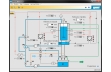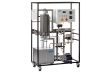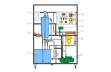

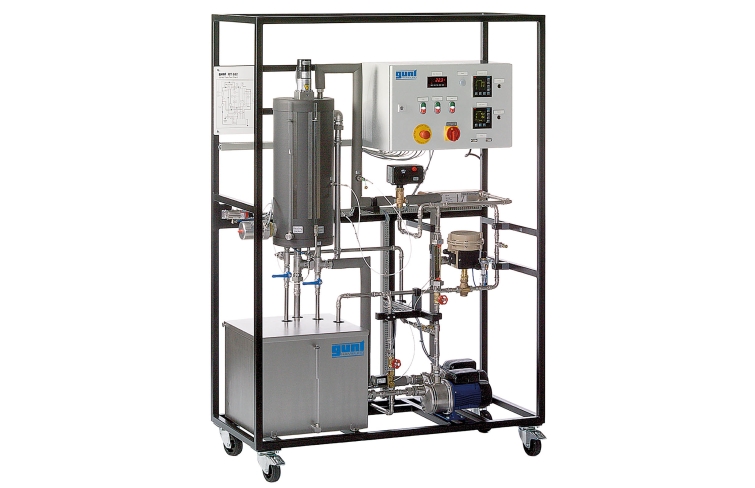
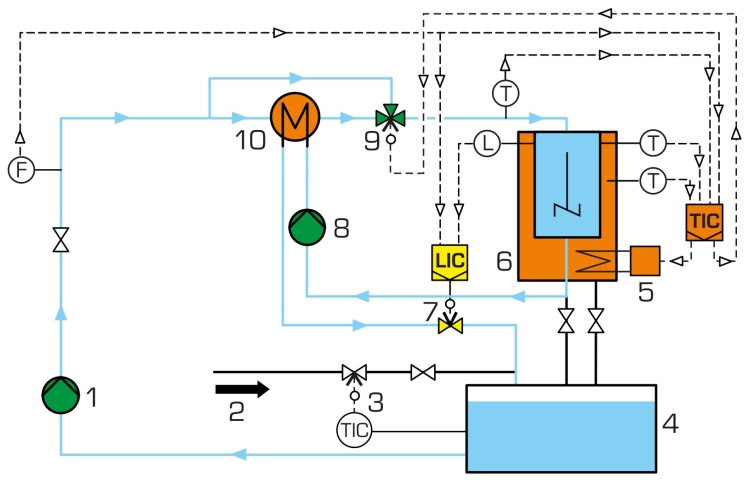
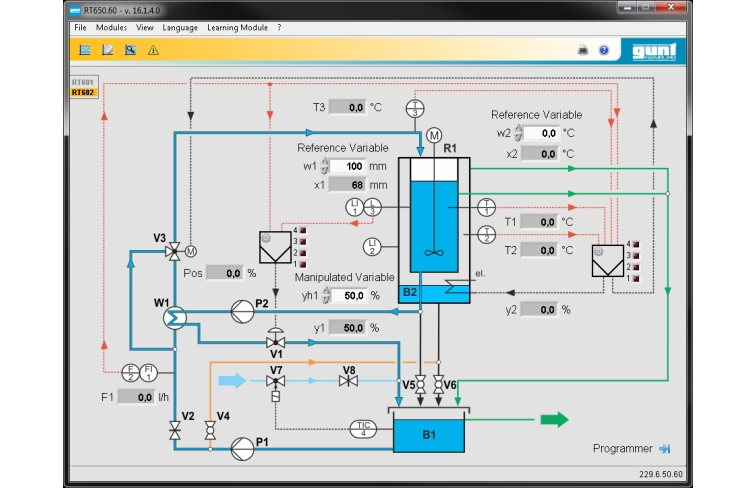
With RT 682 the complexities of a multivariable control system can be learned in a practical manner. The model for the controlled process is a typical application from process engineering: A chemical reaction taking place in a heated stirred tank. The reactants entering the stirred tank are pre-heated by the outflowing products in order to enhance energy efficiency.
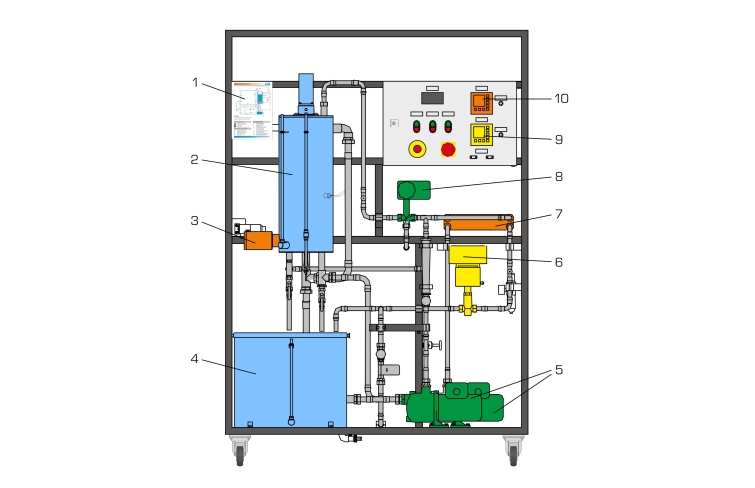
Water is used as the product and reactant for RT 682. A pump transports the reactant out of a collecting tank via a heat exchanger into the stirred tank. The reactant is pre-heated by the heat exchanger. A heater in the double jacket permits control of the temperature in the stirred tank. Another pump transports the heated product out of the stirred tank via the heat exchanger back into the collecting tank. A bypass in the inlet routes the flow past the heat exchanger. A three-way motorised valve adjusts the ratio between the flow heated in the heat exchanger and the flow in the bypass. This is a further method of controlling the temperature in the stirred tank. A control valve changes the flow rate in the outlet and thus the level in the stirred tank. The temperature and level are mutually dependent variables. It is this dependence that makes this multivariable control system so complex.
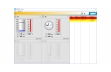
Two industrial controllers are provided as temperature and level controllers. They can be configured and parameterised using a supplied software. The controllers have a PROFIBUS DP interface. The interface permits monitoring of the trainer via an optionally available software RT 650.60. The RT 650.60 software also permits recording of the process variables and parameterisation of the controllers using the PC. It is also possible to interconnect multiple trainers from this series through the PROFIBUS DP interface.